Garage Door Off Track Repair in Paso Robles, CA
Getting a derailed door back on involves holding its weight, guiding it into straight track on sound rollers, and correcting whatever pushed it out so it doesn't happen again.
Rollers that have jumped the track, a door that's tilted or wedged, or a panel bowed where it snagged all mean the door is off track. At your Paso Robles home, stop using it and keep the opener off.
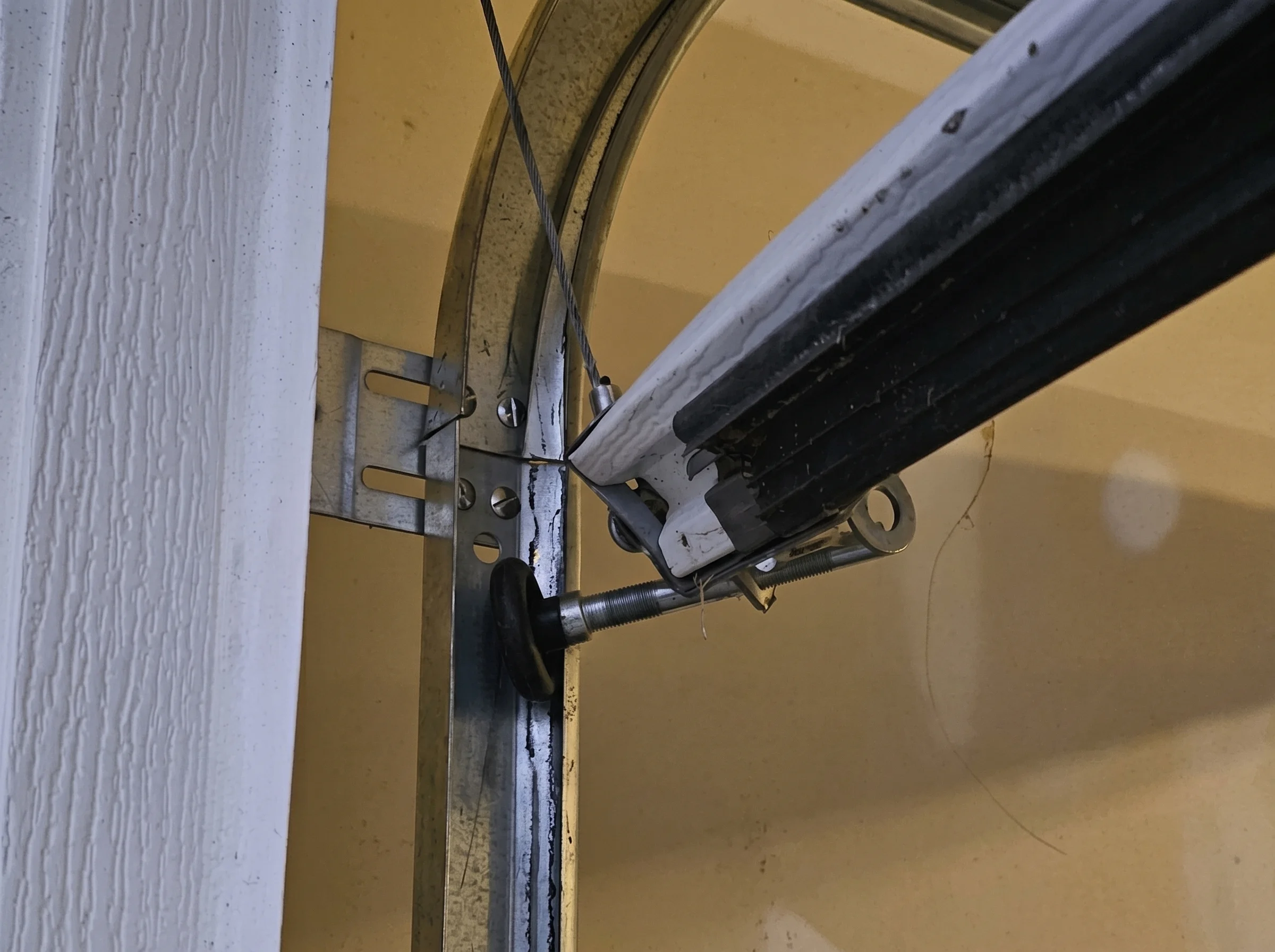
How to recognize a derailed door
At least one roller sits outside the track, typically down low or around the bend where the track curves up toward the ceiling.
A crooked, jammed door, often stopped halfway up.
A panel bowed or creased from the opener continuing to push a stuck door.
Track that is visibly warped, dented or hanging off the wall.
Scraping, grinding or popping noises in the moments before it let go.
Door off its track? Leave the opener alone. Report which side came out and what led to it.
Contact UsWhat knocks a door off track
A hit from a car
A vehicle backing into a door that is shut or partly open is the usual culprit, and the bottom of the track tends to bend too.
A cable that snapped or came loose
One corner sags, the door racks sideways and rollers pop free. When a cable is slack, cable repair covers that part.
Rollers that wore out
Once a bearing seizes, the roller skids rather than turns and leaps out at the first rough patch.
Track gone slack or crooked
Track brackets loosen from years of vibration, and shaking can do it faster; the 2003 San Simeon quake damaged downtown Paso Robles.
An obstruction underneath
Something left in the path. Openers must reverse on contact under 16 CFR 1211, but force set too high defeats that.
First steps
Leave the opener off
It keeps pressing and can crease panels or rip the track off the wall.
Leave the emergency release alone when the door is partway up and off track, because it may drop or swing free of the track.
Never hammer rollers back in. Spring tension is still on the door, so verify any contractor through the Contractors State License Board.
Stand back from the door, and mention a trapped vehicle when you reach out.
What the work consists of
The door is propped and braced first so it can't drop or shift mid-job, and any spring tension is made safe before parts come off.
Damage gets sized up
Which rollers failed, how much track is affected, if panels are bent, and whether a cable or spring set it off.
Track gets trued or swapped out
Small bends are worked out; creased or ripped track pieces are replaced.
Worn or broken rollers are changed, and hinges examined, because a cracked hinge can kick a roller out once more.
The door is lifted back into the tracks, brackets are snugged, and full open-and-close cycles are run. After that, the opener's limits and force get rechecked for the repaired door.
Describe what went wrong
Say what you saw happen in a sentence or two; there's no need to know any of the part names.
Rollers
How quietly and evenly a door travels depends on its rollers, and they wear out well ahead of the door itself.
Bearing-free steel rollers are the entry level: loud, and hard on the track as well as on themselves.
Sealed-bearing nylon rollers are much quieter and need hardly any lubricant or fuss.
A wobbly, flat-spotted, cracked or seized roller is ready for replacement.
A door that is noisy but not broken often needs little beyond fresh rollers, which commonly happens during a maintenance visit.
What shapes the cost of a derailment fix
How far the door slipped out
A pair of rollers on one corner, or the door hanging free.
Condition of track
Whether it can be trued or needs new lengths, on one side or both.
Rollers and hinges that have to go.
Panels bent or cracked
A heavily bowed panel could need replacing, and an older door's panel may be hard to match.
A cable or spring failure that started it.
When a panel can't be rescued
After a hard impact, some panels end up too twisted to straighten. One panel can often be swapped while the remainder of the door stays, provided the manufacturer still makes a match.
If no match exists, or many panels are hurt, garage door installation lays out the replacement routes.
Quick questions
Is it safe to pop the rollers back in myself?
Sometimes, but only for one roller that slipped out low on a shut door with straight track and a tight cable. Beyond that, stop: the door is heavy, carries spring tension, and can move without warning, so wait for someone equipped to deal with it.
Why does the same side keep coming out?
Typically a slightly bent track, a bracket that has loosened, or a cable on that side that's gone out of adjustment. Hanging the door back up without curing the cause just lets it fall out again.
Do the tracks need oil?
No. A clean, dry track runs best, since oil on it picks up grit. Save the lubricant for the roller bearings, hinges and springs.
Related garage door work
Garage Door Spring Repair
Broken torsion and extension springs swapped for ones rated to the weight of your door.
Read more →Garage Door Installation
Brand-new or replacement doors made of steel, wood, composite or glass, cut to your opening.
Read more →Reach out
Tell us where the door has stopped (closed, open or partway), which side came out, what struck it, and whether a cable looks slack.
A photo of each side from a few feet back helps. California requires a license for jobs worth a thousand dollars or more.