Garage Door Spring Repair in Paso Robles, CA
Fixing a spring in the Paso Robles area means fitting one matched to the door's weight and getting the balance right, so the opener and your arm just guide it.
The garage let out a loud crack, and now the door either won't move or rises a few inches and stops. That is nearly always a spring. Leave the door shut and read on before you handle anything.
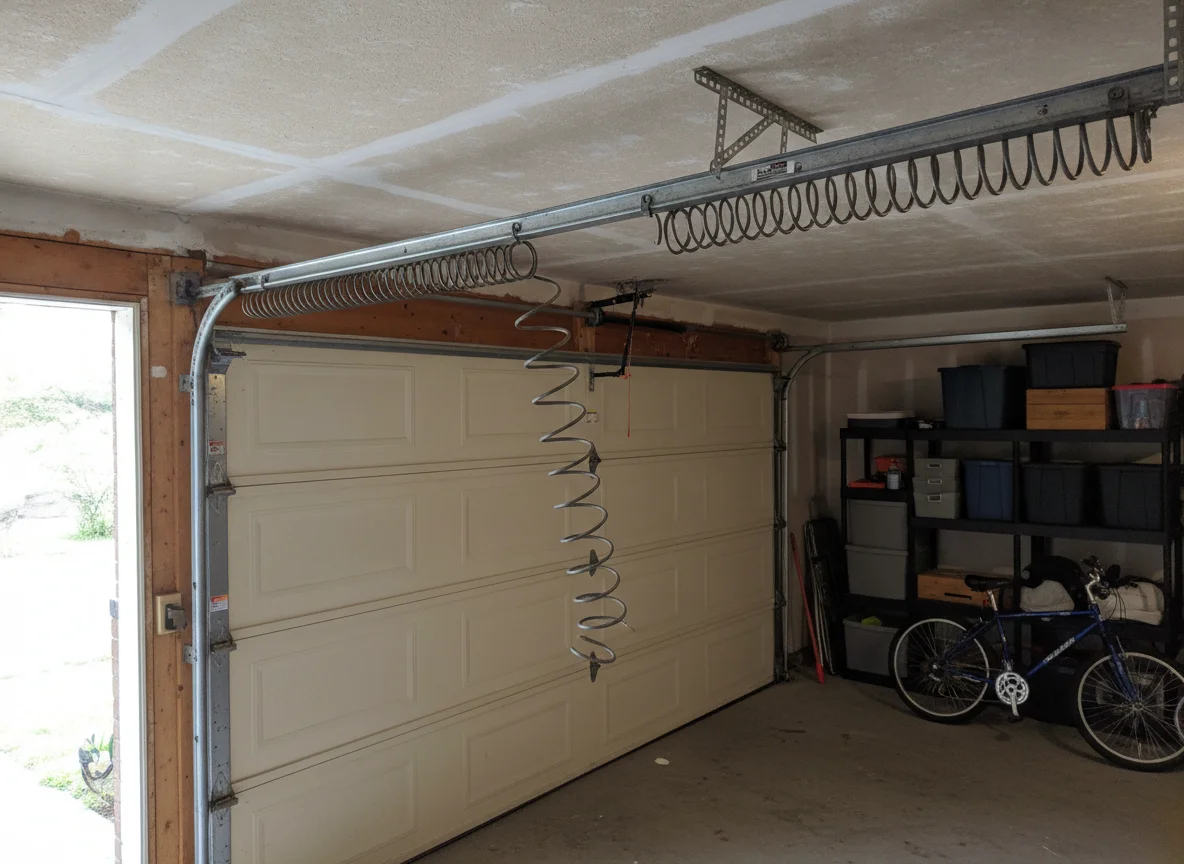
Clues a spring has failed
A bang as loud as a gunshot from the garage, often while no one was near the door. A torsion spring is wound tightest with the door shut, so that is the moment many of them finally snap.
A split in the coil
Look at the spring bar over the closed door. A broken torsion spring leaves a clean gap, often a few inches across.
The door feels suddenly heavy, or won't hold when you lift it halfway.
The opener groans or hums, or raises the door a few inches then quits
Plenty of openers feel the added weight and back off, so it looks like the opener is to blame.
The door rises crooked, one side ahead of the other. When each track has its own spring, one has lost its tension.
It crashes closed across the final foot, with no gentle landing.
Heard a bang and the door won't rise? Leave it shut and describe what you can see over the door.
Contact UsMaking it safe for now
A wound spring can hold enough force to break bones, and a door with a broken one hangs its full weight on whatever else is holding it. Until someone repairs it:
Don't hoist the door by hand or keep hitting the opener button
Openers aren't made to carry a door's weight, and repeated attempts can strip their gears.
Don't pull the red release cord while the door is up
Without a spring supporting it, the door can drop at full weight.
Keep your hands off the torsion spring's tension
Stored energy sits in the winding cones, and they are where this trade's worst injuries happen.
Keep kids and pets clear of the door, and move your car if the door is stuck partway up.
Mention it when you reach out if a car is trapped inside.
Torsion versus extension springs
Torsion springs ride on a steel shaft over the door, twist to hold energy, and turn the drums that reel in the cables.
Recent decades of doors mostly use them. They raise the door more smoothly than extension springs, and a failure is safer since the spring stays on the shaft.
Extension springs lie beside the horizontal tracks and stretch as the door closes. You find them on older, lighter doors. Each should have a safety cable running through the middle, because a snapped spring with none can lash across the garage.
If yours has no cable, correct that whether or not the spring has gone.
Swapping an older extension-spring setup for torsion is possible on most doors, and it is worth raising while the door is already apart for another repair.
How a spring repair goes
Identifying and sizing the broken spring
Wire gauge, inside diameter, length and wind direction have to be exact; guessing leaves the door heavy on one end.
The weight of the door is worked out
The right spring is the one sized for your door's load, not the closest match.
The old spring is removed in a controlled way, with tension let off before a bolt is undone.
The new spring is installed and tensioned, then each cable is inspected on its drum so the two sides rise together.
Balance check and test run
With the opener disconnected, a balanced door stays about where you leave it at waist height, and then runs smoothly through the opener.
Describe the door's behavior
A line or two is plenty to begin with, and you don't have to know the failed part's name.
One or both springs?
With two springs on the door, each has lifted it the same number of times. When one snaps, the second is generally not far behind.
Doing both at the same time avoids a repeat call and keeps balance true, since one new spring working with an old one pulls the door off-center.
Put the question to whoever you call: what do they recommend here, and why? On a one-spring door, ask if a pair would raise it more evenly.
What shapes the cost of spring work
Torsion or extension, plus one spring or two on torsion doors.
Size and weight of the door
A wide door, a solid-wood one or an insulated steel panel set needs a heavier spring than a light single door.
The spring's rated cycles
Every spring carries a rating for how many open-and-close cycles it is built to take. Higher-rated springs cost more but last longer on a door used many times a day.
Other worn parts
Cables that fray at the drums, rollers dragging, or bearings wearing on the torsion shaft cost less to change while the door is already open.
Converting from extension to torsion springs, should you opt for it.
What lifespan to expect
Use counts for more than age. A spring rated for a given number of cycles on a door opened four times a day outlasts the same spring on a door that serves as the household's main entrance by years.
Cold adds strain: Paso Robles sees about 54 nights a year at or below freezing, and springs often let go on the first chilly mornings.
If yours failed earlier than you expected, ask about a higher-cycle spring.
The added cost is usually small compared with a second repair.
Not a spring problem
The coil seems whole, but the door sags on one side or a cable hangs slack
It all works, but the door is slow or loud
A maintenance visit inspects the springs before they give out.
Questions people ask
Can I swap out a garage door spring on my own?
Some homeowners tackle extension springs, as long as safety cables are in place and the door is fully raised and clamped.
Torsion springs are another matter. Winding them needs proper bars and the exact spring specs, and one slip dumps the stored force into your hands. Of every garage door fix, this is where calling a pro protects you as much as it saves effort.
Can I raise the door to get my car out?
Not with a spring down. Leave it shut, and tell us about the car when you get in touch.
Why did a spring break while no one was using it?
A torsion spring is wound tightest with the door shut, and every cycle has fatigued it a little. The last crack tends to come then, and cold makes the steel brittle. December here runs from an average low of 32.6 F to a high of 61.3 F.
Must a new spring come with a new opener?
Rarely. A motor that spent days straining against a dead spring deserves a gear check, though, to see that nothing stripped.
Related garage door work
Garage Door Cable Repair
Worn, snapped or slipped lift cables, and a door that sits crooked.
Read more →Garage Door Opener Repair
Openers that hum, reverse or ignore the remote, plus replacements when repair doesn't pay off.
Read more →Garage Door Maintenance
A routine check of springs, cables, rollers and safety reversal, done before anything fails.
Read more →Reach out
Say if it's a single or double door, what you heard, whether it moves at all, and if a car is inside.
A photo of the spring from the floor with the door shut shows the type and break. Check any contractor with the Contractors State License Board to see license status.